Tuesday, August 24, 2010

I Kid You Not: To Be The Best, You Need To Beat The Best

I realized something really important this weekend—while watching the NASCAR race, as a matter of fact.
I love ranting, especially about sports.
This particular rant centered on Kyle Busch, the brash, cocky, “checkers-or-wreckers” driver of the No. 18 Toyota for Joe Gibbs Racing in the Sprint Cup Series.
The younger Busch (Kyle’s older brother, Kurt, also races in NASCAR’s top series) made history this weekend by winning all three races—the Craftsman Truck Series race on Thursday night, the Nationwide Series race on Friday night and the Sprint Cup Series race on Saturday night—the first such sweep in NASCAR history.
For one thing, I was already in a bad mood because my driver, Jimmie Johnson, got wrecked by Juan Pablo Montoya after a restart less than halfway through the race. And for another, I really, really don’t like Kyle Busch. He’s cocky, he never, ever admits that anything is his fault (unless it’s in a sulky, “well I guess since so-and-so is never wrong, I guess it must be my fault” sort of way) and he tweaks the last nerve of even the most easy-going drivers on the circuit (such as Jeff Burton, Mark Martin and Joey Logano).
Basically, he’s trying to be Dale Earnhardt, but instead of coming across as the stone-faced, ice-water-in-his-veins intimidator, he comes across as a whining, petulant little child who probably just needs a good nap.
So, as the ESPN commentators waxed poetic (or whatever they call it when Dale Jarrett and Andy Petrie yammer on and on into the night) about Busch making history, all I wanted to do was calmly point out (read: shout at the top of my lungs) that the only reason Busch “made history” is because he insists on racing against inferior opponents every single week.
Here’s the thing, if you’re unfamiliar with how NASCAR’s various series work, compared to the farm system in Major League Baseball—the Sprint Cup Series is like the major leagues, the Nationwide Series is like AAA, and the Craftsman Truck Series is like AA. Or if we compare it to football, Sprint Cup is like the NFL, Nationwide is like college football, and the truck series is like high school. The point is, each of these series is there to serve the purpose of allowing younger drivers to gain racing experience in a more challenging environment than the local track can offer, while simultaneously allowing older drivers to continue racing, thereby also giving the young drivers access to veterans who can teach them a lot of valuable racing information. It’s a great system for maximizing the young talent coming up the Sprint Cup series.
Except that drivers like Busch (and Dale Earnhardt Jr., and Carl Edwards, and Clint Bowyer, and Kasey Kahne, and Elliot Sadler, and Ryan Newman) insist on driving in the Nationwide Series (and some in the truck series) to…I don’t know, gain more experience? That’s the standard excuse, but you have to think that this “seat time” is a little overrated, given that only two of those drivers (Edwards and Kahne) finished in the top 12 in the standings last year.
I’m not saying these guys are all egomaniacs or anything, but (as someone who enjoys creating myself and my friends in Madden on my Xbox 360, then rolling up victories of more than 100 points on my opponents) I have to admit that there’s something really fun about going up against an inferior opponent and utterly destroying him. It makes you feel all warm and fuzzy inside, like a cuddly baby bunny stiff-arming a linebacker to the ground and diving into the endzone.
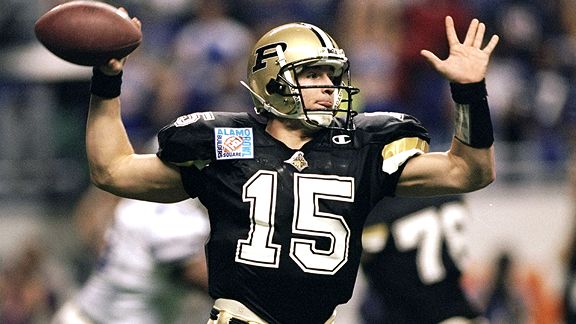
But there is definitely some kind of ego wrapped up in a decision like this, because it’s not like you see Adrian Gonzalez flying up to Portland to play for the Beavers and see some more pitches before he steps in against the Dodgers. Nor do you see Drew Brees fly back to Purdue to lead the Boilermakers on Saturdays before he straps on that Saints helmet on Sundays. Nowhere else in sports do you see a major-league level athlete purposely compete against minor-league opponents other than in NASCAR.
With most of these drivers, it’s probably a combination of wanting to have more success and just not knowing what else to do with their time. One thing I’ve learned about racecar drivers over the years is that when they’re not racing, they’re thinking about racing. And when they’re not thinking about racing, they’re dead. So these guys probably just like racing.
And I’m sure that’s part of it with Busch as well, but the spoiled, whiny kid I hear in the post-race interviews tells me that he just wants to be better than other people, even if he has to take on someone who is decidedly not his own size, metaphorically speaking.
Personally, I think NASCAR should consider some kind of rule to regulate which drivers are allowed to drive in which series, for the good of the sport. If you think about it, if the seven drivers I just mentioned who drive full-time in both the Sprint Cup and Nationwide series had to decide which series to race in, that would open up seven seats to younger drivers who could use the added experience before they made the jump to the Sprint Cup Series.
Here’s what I would suggest—allow a driver to run in no more than two series at a time, and after he has been run a full schedule in the Sprint Cup Series for three consecutive years, he is no longer eligible to race in any other series, unless he stops racing full time in the Sprint Cup Series. That way, once you get to the big leagues, you can’t take your talents down to the minor leagues and dominate.
Which brings up my final point—these guys should be dominating the Nationwide series (and especially the truck series)! Kyle Busch is an elite stock car driver in the prime of his career! The fact that he doesn’t win every truck race and every Nationwide race should be more of a point of personal shame than the elation brought about by winning every now and then against what are essentially kids still learning the sport and old guys out for a good ol’ time at the track.
Perhaps it’s a symptom of our generation—look at what LeBron James just did, for example. Instead of wanting to carry a team and prove he’s the best basketball player of his era, he decided he wanted to beat everyone else, so he teamed up with his talented buddies to tip the scales in his favor. A number of writers have pointed out that James is like that annoying guy who comes out to play a pickup game, makes sure he stacks the teams with the best guys there, then trash talks you the whole game. At some point, it became more fun to win as the beneficiary of a loaded team than it is impressive to work really hard and be the best at something because you earned it.
The other side of that coin is that there are still, thankfully, a lot of athletes out there who go for glory with everything they have. Athletes like Brees (who went to New Orleans, brought a team and a region back to life with his energy, enthusiasm and talent, and won the Super Bowl), or Albert Pujols (who led the St. Louis Cardinals to the World Series title back in 2006), or Sidney Crosby (who won the Stanley Cup with the Pittsburgh Penguins in 2009) show us that there is still hope for athletes who work hard, learn from failure, and ascend to the pinnacle of their sport.
Kyle Busch could learn a few things from these guys.
As always, if you have any thoughts on this topic, or any topic, be sure to write to us at sports@valleycenter.com and tell us all about it.

Thursday, August 19, 2010

I Kid You Not: Fantasy Football Sleepers & Snoozers 2010

You love football, I love football, and in less than a month, we’ll all be happy campers once again.
But for those of us who can’t get enough of the NFL with just the weekly games, there is fantasy football.
Although some may call it a fake sport, or just another way for nerds to crunch numbers, you can’t argue with the stats. Depending on where you get your stats, anywhere from 23 to 29 million Americans play fantasy football every year, and if you’re one of them, you know why.
The thrill of competition, the feeling of being involved with the players on your team, the simple joy of a T.J. Houshmandzadeh touchdown catch to help you beat Larry from accounting—it’s all just a part of the wonderful package.
If you’ve played fantasy football before, then you know how many opinions are out there masquerading as facts, telling you why a certain player is doomed to fail this season, or why you should avoid a certain player because it’s a surefire guarantee that he’s not going to make it through the season healthy.
If you’re new to fantasy football, it can seem a little overwhelming. But if you’re a veteran of the fantasy world, then you know how to take in all this raw data and form your own educated opinions, which are hopefully turned into beneficial decisions.
If you’re really good, you might start to express your own opinions to those around you. And since I’m one of those guys, I’m going to tell you who I think are some players with solid potential (sleepers) and who are guys I wouldn’t really want on my team (snoozers) for this season.
If you want hard data on these guys, there is no shortage of places to go to find what you’re looking for. The following is nothing more than one man’s opinion. Granted, one incredibly awesome, gifted, never-finished-worse-than-third-in-at-least-one-of-my-fantasy-leagues-since-I-started-playing kind of guy. But still—opinions they are.
With no further ado, let’s look at some players to snag and some players to avoid in fantasy football this year.

Sleepers

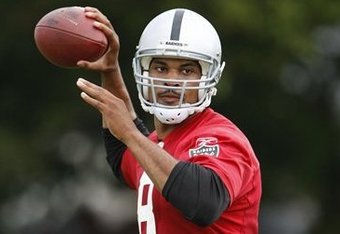
QB: Jason Campbell, Oakland Raiders
I know—the Raiders, you ask? Let’s just say that no team is going to look good when Jamarcus “That’s No Moon, That’s Our Quarterback” Russell...
...is overthrowing your receivers by 15 yards. Campbell is an accurate passer who brings confidence to an offense with some talent, but was mired in the cold, slippery grip of incompetence the past few seasons. They’re not going to win the Super Bowl, but Campbell will put up solid numbers all season.

Matthew Stafford, Detroit Lions
We saw some glimpses of Stafford’s ability and toughness last season, when he led the Lions to a last-minute victory over the Browns with an outstanding two-minute drive, shaking off a shoulder injury to re-enter on the final play and throw a touchdown pass that won the game. He’s still got his primary target, Calvin Johnson, as well as some new, potentially exciting talent on offense. I’m not saying he’s going to win the MVP, but if you still need a quarterback and he’s there in the late rounds, you could do a whole lot worse (see Jackson, Tarvaris).

RB: Ronnie Brown, Miami Dolphins
I’m a little biased here since I’m a Dolphins fan, but Brown has been a top-three fantasy running back at some point in each of the past four seasons. The reason he’s so commonly overlooked is because he was only able to finish one of the past four seasons, due to various injuries. Now, I can’t claim to know what will happen in the future. Well, I can claim that, but most of you would probably not believe me. Anyway, there’s a chance he could get hurt. But there’s a chance any player could get hurt, and Brown’s injuries were kind of fluky: a broken hand from a collision with an opponent’s helmet (2006), a torn ACL in his knee while making a tackle on an interception (2007), and a Lisfranc fracture in his right foot (2009). The ACL tear is a bit concerning, but he’s now gone two full seasons without any problems there, so why is there so much doubt that he will be healthy this year, any more than any other player? For fantasy purposes, you look at the potential cost/benefit analysis. Potential reward, you draft a top-ten fantasy running back (maybe better) with a fourth-round pick. Potential cost, he gets hurt and your fourth-round pick goes down the drain. To me, that’s not a huge risk. I mean, who else are you going to grab in that spot, Justin Forsett (who isn’t even the starter) or Jerome Harrison (of the Cleveland Browns… let me repeat that—THE CLEVELAND BROWNS)? Why not take a chance on a guy who has the talent and the opportunity to be an elite back?

Cadillac Williams, Tampa Bay Buccaneers
This one is for the late rounds, because I don’t really think anybody from the Tampa offense will be that great. But despite the seeming committee in the Buccaneer backfield, Caddy showed some promise at the end of last season after coming back from a torn patellar tendon the year before. He was outstanding in his rookie season (2005) and is just now finally coming all the way back from that injury. Instead of stocking up on kickers, I’d be willing to give Cadillac a test drive (note: I’m pretty sure this is the only time anyone has ever used that joke. Ever. Pretty sure.)

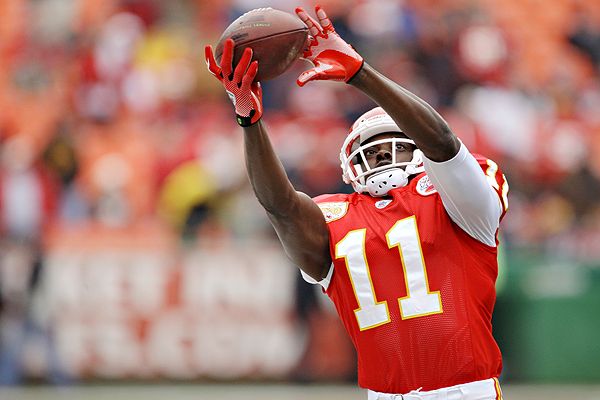
WR: Chris Chambers, Kansas City Chiefs
Look, there isn’t much to get excited about when you look at the Chiefs this year. Until last year, their quarterback made a living watching other (or rather, more talented) quarterbacks win football games—Matt Cassel was the backup to Carson Palmer and Matt Leinart at USC, then spent four seasons as Tom Brady’s designated baseball cap holder in New England. Their running backs either have some pretty good potential (Jamaal Charles and Dexter McCluster) or might be running out of gas (Thomas Jones). The offensive line isn’t great either, but word is that it might be getting better—emphasis on “might.”
Their receivers aren’t much to look at either, but one thing we learned from the last half of 2009 was that Cassel somehow developed a rapport with Chambers, the number two wideout on the depth chart this year since Dwayne Bowe is pretty solidly established as the primary target.
Now I’m not saying that the Chiefs’ passing game is going to be electric, but I am saying that there seemed to be a connection between Cassel and Chambers last season, especially down the stretch—you know, when fantasy football match-ups are kind of important. If he’s still around in the later rounds, he’s probably going to be a good deal.

Josh Morgan, San Francisco 49ers
Pretty much, what I said about Chambers, apply that to Morgan. Also, Morgan is younger and his quarterback actually played in college.

Derrick Mason, Baltimore Ravens
Everybody’s all ga-ga for Anquan Boldin, and with good reason. But in my opinion, all his arrival does is open up more opportunities for Mason, who is as sure-handed as any number two receiver out there. The Ravens have a pretty exciting offense this year, and the way Ray Rice runs, you know there will be open spots for Mason in the secondary. Again, I don’t think he’s good enough to be your number one WR or anything, but if he’s there in the sixth or seventh round, I think you’ll do fine with him.

TE: Jermichael Finley, Green Bay Packers
Everybody thinks that Aaron Rodgers is going to have a monster year, and I agree. Finley is young, big, fast, and has great hands. He’s going to gobble up touchdown after touchdown this season.

Snoozers

QB: Donovan McNabb, Washington Redskins
McNabb is a tough place to start with the snoozers, because I don’t mean to imply that he’s going to be worthless. I just don’t think he’s going to put up the kinds of consistent fantasy numbers that he did last year with the Eagles. It’s a different system, he’s got new receivers to work with, and the ‘Skins actually run the ball from time to time. McNabb will end up with a decent season, I’d wager, but probably nothing significantly higher than Jason Campbell’s season totals for Washington last year. Basically, McNabb isn’t going to be as good as he was last year, so I would just be careful how high you rank him.

Carson Palmer, Cincinnati Bengals
Like Rodgers, a lot of people think Palmer will have a big year. He’s got the Ochocinco/Owens circus to ringlead, a (supposedly) talented rookie tight end, and a healthy Cedric Benson carrying the load. It looks really good on paper.
But they don’t play games on paper, probably because that would be a waste of paper, and it’s much easier to just play the game on your computer like the rest of us. Anyway, this is purely a gut thing, but I don’t think Palmer will be all that valuable come season’s end. He’ll have his days, I’m sure, but he plays some tough defenses (Pittsburgh and Baltimore twice each, New England, Atlanta, San Diego and the New York Jets among them) and he hasn’t really been all that great the past few seasons. I don’t think that another narcissist wide receiver in the locker room is going to help his demeanor much.

RB: C.J. Spiller, Buffalo Bills
He looks like he’s got lots of potential right now—good speed, an offense committed to the run, and the other two potential starting running backs (Fred Jackson and Marshawn Lynch) have picked up some minor injuries in the preseason.
But one of my new favorite words for this season—“meritocracy”—comes into play here. Jackson led the team in rushing last season, and Lynch is still a big, physical back who can pick up tough yards. Spiller may have talent, but in the NFL, the ball goes to the guys who earn it. Until Jackson and Lynch completely blow it out there, I feel like Spiller is doomed to a few chances here and there, at best.

Joseph Addai, Indianapolis Colts
He’s getting older, he plays on a team that doesn’t run very much, and he’s got a younger guy (Donald Brown) behind him who, according to the “insiders” who seem to know these things, is going to get more chances this year. Even if Addai gets the bulk of the Colts’ carries, he hasn’t really done much with them the past few years.

WR: Chad Ochocinco, Cincinnati Bengals
Read what I wrote about Carson Palmer again. Then add to it the fact that Ochocinco A) isn’t getting any younger (or faster), B) clearly doesn’t like sharing the spotlight, and C) gets easily frustrated when things aren’t going well. The Bengals play at New England to open the season, then host the Ravens in week two. I can’t imagine them winning either of those games, much less both. It could be a rough year in that locker room.

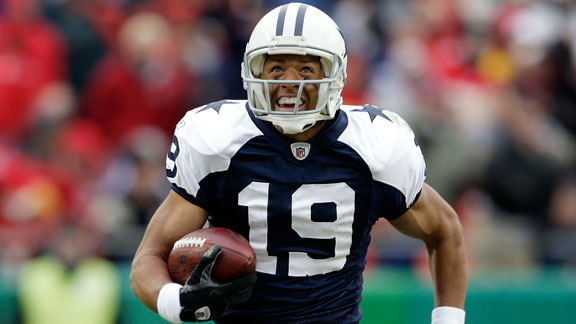
Miles Austin, Dallas Cowboys
This one is similar to McNabb in that I’m not saying Austin will be terrible—I just think that all the hype has gotten a little out of hand. The Cowboys played well and Austin got a lot of points last year, but defenses kind of know he’s coming this year. Chances are he’ll get taken really early, and chances are, the guy (or girl) who drafted him in your league will end up just a little disappointed.

Any Receivers From The Pittsburgh Steelers
(like Mike Wallace...)
(oops, wrong Mike Wallace...um...here we go...)
Ben Roethlisberger is out for six weeks, and Byron Leftwich is no longer the same dude that got carried by his offensive linemen to run the two-minute drill at Marshall. Super Bowl MVP Santonio Holmes is gone, Hines Ward is still good but getting old, and I’m not entirely convinced that Mike Wallace (no, not the guy from 60 Minutes) can be considered elite. It’s not like they’ll be terrible, but for where they’re going in mock drafts right now, there are better guys out there.

TE: Greg Olsen, Chicago Bears
His quarterback likes throwing it to the other team, he’s got a much older guy pushing him for the starting spot (Desmond Clark), and his new offensive coordinator doesn’t really do much to get the tight end involved anyway. Yeah, you remember the Rams from the late 1990s, with Mike Martz as the offensive coordinator? The guy who helped make Kurt Warner, Isaac Bruce, Torry Holt and Marshall Faulk into superstars? Can you name the tight end from the 1999 Rams? It was this guy. In 16 games, he had all of 25 receptions. Not exactly lighting up the fantasy scoreboard.
— — —
There you have it, the official I Kid You Not sleepers and snoozers. Take this advice, go forth, and dominate your league.
Or wonder whether or not I gave you a bunch of false leads just to throw off any of the other owners in my league who might be reading this column. Maybe I’m giving good advice, or maybe I’m watching out for my own interests. I will let you decide.

Wednesday, August 11, 2010

Why Football Is King

I looked my wife in the eye one day this week and confessed to her that I have a problem.
“It’s only August,” I explained. “And I already can’t wait for football to start.”
As she sympathetically (sarcastically?) assured me that this month will fly right by, I reflected on the fact that there are very few things that can get my insides all squirrelly a full month in advance. Granted, I love Thanksgiving and Christmas as much as the next guy, but once you get past the age of 12, there really isn’t much to get excited about. Except being able to stuff your face, but you can really do that any other day of the year. I mean, this is America, after all.
In the realm of sports, there really isn’t anything that I get this excited about. I grew up playing baseball, and I still get to relive my glory days (those being my MVP season for the City Rec League Astros in the summer of 1993, complete with the accompanying soundtrack of You’re The Best Around by Joe Esposito) on the slow-pitch softball field. I loved watching the World Cup this summer, I really enjoy hockey season (when I can actually find a game on TV, which is rare), and going to see the Padres play is always a good time (especially this year, when they’re actually going to win the division even though they’re going to fold like every other year).
But none of these things really get me pumped up the way that football season does. And I’m not just talking about the NFL, either, although that is the main source of my anticipatory glee. I talked with Valley Center varsity football coach Rob Gilster this week about the Jaguars’ upcoming season, and I have to say, I’m really looking forward to Friday nights this fall. (Be sure to check out the 2010 VCHS football preview to your left).
So I started wondering, what about football season sets it apart from all these other things I enjoy? And why do so many people seem to feel the same way?
I think there are three things about football that make September one of the most anticipated months of the year. And since I like you so much, I’m going to share these three things with you right now. You’re welcome.

1. The Ideal Format
The most basic level of enjoyment in the world of sports comes from simply being able to watch a game. Whether you like the teams or not, whether you fully understand the strategy or not, or if you just want to spend an enjoyable evening with friends, sports are a lot of fun. So the more games there are, the better, right?
Wrong. The Padres play 180 games every year, and last season, they averaged under 24,000 fans in attendance per game. That’s slightly over half the capacity of Petco Park. Ouch. And that’s not saying anything against the Padres, it just proves the point that a Thursday night game in April against the Milwaukee Brewers (attendance: 16,696 for the game on April 29 of this year, by the way) just can’t help but be met with a bit of a collective yawn. Honestly, once anything starts to reach a level of oversaturation, it loses some of its appeal.
In contrast, the Chargers haven’t had a regular-season game blacked out (NFL rules stipulate that a game won’t be shown on local television if the team hasn’t sold all the tickets for that game) since 2004, and there are plenty of news articles written about how the Chargers aren’t exactly the best in the league when it comes to selling out games. And even though NFL tickets are exponentially more expensive than MLB tickets, the Chargers sell out their home games because fans know there are only eight of them every season (plus a few playoff games, if they get there). When something cool only happens eight times a year, it’s a lot more likely that you’ll plunk down the $50+ just to go see it. Even if the team is lame, it’s still better than snoozing through another Jon Garland-vs.-Adam Wainwright one-run shoot-out (from May 25 of this year, attendance: 18,236).
Which brings up another point—football is just more fun to watch. The play happens, there’s a little break for some replays, then another play happens. It’s not stare-off-into-space-while-contemplating-the-cosmos boring like baseball can be, but it’s not continuous action like hockey and soccer. You get to see stuff happening, but you also get little pauses to allow the analysts to help you understand what just happened. As far as fan-friendly sports go, football has the ideal setup.
That format even extends to the way the season plays out. Because each team only plays one game each week, fans only have to block out one day a week to watch their favorite team. If you really want to devoutly follow the Toronto Maple Leafs or the Cleveland Cavaliers (although I can’t imagine why) or the Texas Rangers, you pretty much can’t have a life during the season. Not that anyone who is a diehard Cavs fan can claim to have much of a life anyway, but at least a committed football fan has the luxury of six days a week to do other things. Granted, most of us football fans use those six days to dissect every play that happened on Sunday (or Monday night), but still, it’s nice to know we could have a life.

2. The Popularity
I’ve admitted before that the way my sports fanship has come about is because of my sports hatred. Basically, the teams I like are the rivals of the teams I don’t like. I like the Miami Dolphins because I grew up in Western New York and was sick of all the Buffalo Bills fans. I like the Mets and the Red Sox in large part because I can’t stand the Yankees.
A lot of the reason why I don’t like certain teams is because they’re overly popular. I still can’t talk about Jim Kelly, Thurman Thomas or Andre Reed without getting a look of snarling anger on my face, because when I was growing up, all the Buffalo-area news stations would just gush about the K-Gun offense and Marv Levy and Cornelius “The Biscuit” Bennett and the amazing (read: cheating) comeback against the Houston Oilers in January of 1993 and all the rest.
So why would I advocate the benefits of enjoying something that’s popular?
I’m glad you asked. Really, it comes down to accessibility and the potential for enjoyment that comes from being able to get into something easily.
And football is easy to find. If you want to know who will be the starting running back for the Seattle Seahawks this season, there are plenty of experts whose job is to watch the Seattle Seahawks and tell the world which tailback figures to get the most touches this season. If you want to find out how to spot an outside linebacker blitz, I know of at least four different shows on television that feature experts explaining these “X’s and O’s” kind of details. If you want to know which NFL player Kim Kardashian is currently exploiting dating, it doesn’t take more than a couple clicks of the mouse.
In short, it’s not hard to go from casual fan to diehard with very little personal effort. My wife is a good example—back before we got married, I started inviting her over to watch football with me on Sundays, and before the end of the season, she knew more about some teams than I did. OK that’s probably a bit of an exaggeration, but not really by a lot. She knows her stuff, and she’s looking forward to the season almost as much as I am.

3. Fantasy Football
The final threshold for the transition from casual fan to diehard, fantasy football is almost a sport in and of itself. It falls into the previous two categories we’ve discussed (it only happens once a week and it’s popular) which makes it an ideal way for football fans to add another layer of enjoyment to the game.
I’ve played fantasy football for the past seven years now, and I have to say, I’m probably more excited about my various FFL (Fantasy Football League) drafts than I am about the NFL’s opening weekend.
If you still don’t know what fantasy football is (apparently those people still exist), it’s basically a league of people who take turns picking the various NFL players to form their own teams. Each player earns a certain number of points based on how he performed in his NFL game that week (as in, if Tony Romo throws a touchdown pass, he gets six points for his FFL “owners”) and the teams in each FFL compete against each other using these point totals to determine a winner each week. There are different formats and different scoring rules depending on the league, but the basics are the same.
What fantasy football does is give football fans an excuse to be interested in players and teams that they may not pay much attention to otherwise. Last season, I had Washington Redskins receiver Santana Moss in one of my leagues. Would I pay much attention to the Redskins if I didn’t have Moss? Probably not. But because I counted on him as my number two receiver, I had to find out if he was getting the ball as often as he should, and if he was getting chances to score touchdowns, and if he had any injury concerns. I learned more about a player, his team, and other players at his position because I was invested in my fantasy league.
And before you wonder just how big of a nerd I am, I have to say that all the investigation I did took very little time. Fantasy football is pretty universally free these days, and especially if you go with a site like ESPN.com, you get outstanding updates, live scoring and all the latest tools right at your fingertips. We literally had a seven-year-old owner in one of my leagues last year, and he did pretty well. He made it to the playoffs, if I remember correctly, and that’s not exactly a given.
I’m planning on writing a more robust fantasy football column in the next few weeks, complete with a few of my sleepers and snoozers, so if you’re at all interested in fantasy football, check back with us each week and be sure to write in to sports@valleycenter.com to share your thoughts on the subject.
In the meantime, I’m going to go curl up with a recording of Tom Jackson breaking down the zone blocking scheme in minute detail.
And I’m going to count the minutes until September.

Tuesday, August 3, 2010

I Kid You Not: Football, Soccer & Teams With Disasters For Names

If I were 12 years old, I would be pretty upset with the Target Corporation.
To be fair, I’d probably be less than happy with almost all the retailers out there this time of year, because it seems like it gets earlier and earlier every summer that they insist on reminding us that summer is winding down, thanks to a slew of “Back To School!” banners, commercials and ads in the newspaper.
But for as much fun as summer is when you’re a kid, there’s really not much in it if you’re a sports fan. Sure, there’s baseball, but who wants to watch two guys play catch for three hours (unless it’s a Red Sox-Yankees game, in which case it’s more like four)? NASCAR is going strong, but the summer months feature some of the most boring races (Pocono, Indianapolis, Chicago, Michigan twice... yawn) and The Chase is still more than a month away. Things have gotten so bad that I actually watched a Major League Soccer (MLS) game last week. Let’s just say that MLS is not so exciting after you’ve gotten used to World Cup soccer.
But even in a summer when the weather can’t seem to make up its mind (we just went through San Diego’s coldest July in nearly 100 years), I still had a few random thoughts about sports this week that I would like to share with you.
As always, I would love to hear your thoughts about these, or any, sports-related topic. Send me an e-mail at sports@valleycenter.com anytime and we’ll get a good discussion going.

I’m Sure The Browns Would Still Be Terrible
Watching the World Cup this year was a really fun experience, and I feel like I learned a lot about soccer. If I lived in Europe—or if it didn’t cost an arm and a leg to watch English Premier League (EPL) soccer here in America—then I would probably watch more of the world’s elite soccer players battle it out on the pitch.
One little detail about the EPL that I find fascinating is the idea of relegation.
Basically, the Premier League consists of the top 20 soccer teams in England and is affiliated with The Football League, which consists of 72 clubs split evenly between three divisions, The Championship League, League One and League Two.
I suppose the simplest way of putting it is to say that, at the end of each season, each of these four divisions changes teams. The top three teams in the three lower divisions get to move up to the next division, while the bottom three teams from the top three divisions move down. It sounds complicated, but it makes sense.
The idea is that the Premier League is reserved for the teams that are the best of the best, but each team’s spot in this league is not a guarantee. You have to earn your chance to play in the EPL every season.
I absolutely love this idea for other sports. For one thing, you’re not watering down the competition between the good teams by making them have to play pushovers. For another thing, you’re giving teams in rebuilding years a chance to play meaningful games against opponents who are more closely matched in talent, making for more exciting games. It’s the best of both worlds.
Imagine if this concept were to be applied to the NFL. Right now, there are 32 teams in the league, and honestly, it’s not hard to say that 16 of those teams are legitimate, while the other 16 are middle-of-the-road, at best. Take the top 16 teams (according to last year’s standings, the top 16 teams in the league were Indianapolis, New Orleans, San Diego, Minnesota, Green Bay, Dallas, Philadelphia, New England, Cincinnati, Arizona, New York Jets, Baltimore, Atlanta, Pittsburgh, Houston and one of the teams that finished 8-8, which were Carolina, San Francisco, Denver, New York Giants and Tennessee) and separate them into the NFL Division I or something like that. Then put the other 16 teams in Division II and have them play against each other all season. At the end of the year, the bottom three from Division I get sent down, while the top three from Division II move up. It adds more drama to those games at the end of the year, especially for those teams who aren’t going to make the playoffs. More meaningful games are good for all of us.
Of course, the teams that stink wouldn’t be happy about it… at first. But I have a feeling they’d all get used to it, because they’d still be officially in the NFL, they wouldn’t be getting blown out, and they’d have a chance to play for the Division II championship (which could be held the week before the Super Bowl to save us all from the disappointment that is the Pro Bowl) at the end of the season. It’s hard to get excited about a game between the Browns and the Panthers, but if a win meant that one of them got a shot at moving up to Division I, then the intensity gets ratcheted up a notch. Again, how could anyone turn down a chance to see more games that mean something?
The only potential downside I can see is that it’s hard to get better if you’re not playing against better players. But I think the competition level in the NFL, across the board, is such that even the worst teams in the league still have players who are playing at an elite level. Just because the Rams only won one game last year doesn’t mean that Steven Jackson isn’t a talented running back.
And with the way that the NFL goes through cycles (remember when the Colts and Patriots were terrible?), I think we would still see those cycles play out like they have in the past. The NFL would have to tweak the draft rules just a bit—perhaps they would have Division II draft first, going in the inverse order of the standings, then have the Division I teams follow after—but I think things wouldn’t change much. A few good players can turn a franchise around, and it can happen at just about any time.

On The Plus Side, We’d Get To See More Of Brooks Bollinger
Another NFL idea I’d like to see put into action is the concept of a minor league farm system, similar to what we have in baseball and hockey.
Each Major League Baseball (MLB) team has a series of minor league teams in the farm system—meaning that if a player on the MLB team gets hurt or traded, the club can “call up” a player from the top minor league team to replace him. Each minor league team is affiliated with an MLB team so the pro team can develop the talent of young players before bringing them up to the big leagues. It’s the same in the National Hockey League (NHL), only each NHL team only has one minor league team instead of a whole farm system.
Why hasn’t anyone tried this in the NFL? I guess the popularity of football is still relatively new, and it would be a pretty serious undertaking to get the logistics worked out for the creation of 32 minor league football teams. But I have a feeling that the investment would more than pay off, and I don’t think it takes a genius to get the ball rolling.
Let’s say that we could convince 32 multi-millionaires that it would be totally cool to own your own sports franchise. A stretch, I know, but… we’ll just call it a hypothetical. Anyway, we get 32 rich guys (or gals, there’s nothing wrong with that. Other than still using the term “gals” I mean. I digress.) to pony up enough to pay for players, coaches, uniforms, staff, stadium use and team travel expenses. The league would have to set some kind of a salary cap to keep things reasonable (ideally, you’d want some kind of system that only allows you to pay a certain maximum based on a player’s experience and position on the field), but we’ll skip that for now.
What would be great about the DFL (Developmental Football League)—or whatever it would be called—is that you wouldn’t really have to change much about the structure of the current NFL squad. Each team is allowed to have 80 players on the roster during training camp. Throughout the summer, a series of cuts is made, brining the roster down to the regular season size of 53. Of course, during the season, each team can only have 45 active players dressed for each game. Those eight who are not dressed are the members of the practice squad, or scout team.
If each NFL team had a minor league affiliate, they wouldn’t need to make all those cuts, just a decision about who plays in the big leagues and who gets sent down. Keep those 45 players for the NFL team and you still have 35 left over from the 80 you brought to training camp. And there are always plenty of unsigned free agents out there after the draft, so I don’t think teams would have trouble finding another ten guys who want a shot at playing pro football.
Here’s the genius of the plan, though—because of the popularity of college football, the NFL draft has become a big-time event in and of itself. We want to see where Tim Tebow is going to play his pro ball. We want to know what will happen to Jimmy Clausen, Jahvid Best, C.J. Spiller and Ndomukong Suh.
With a developmental league, these players would all get to play every week, and we’d get to watch their development. Watch Tim Tebow learn to read the cover-two defense. Watch Jahvid Best learn to pick up a pro blitz. It’s riveting.
Plus, if an organization were to be particularly on the ball, you could have a similar system in place for both levels (for example, if the Philadelphia Eagles run a West Coast offense, then their minor league team should also follow suit). It would be a lot like the high school system of varsity and JV, with different coaches following the same system. And something tells me there would be no shortage of coaches who would be more than happy to sign up for this kind of a chance.
Really, the only detail that’s left is to start picking out the names of the minor league teams. I still can’t decide if it would be easier for the teams to play in the same stadium as their NFL counterparts or if they should have their own (nearby) cities. If they used the same stadium, they could just follow the NFL team’s schedule, but reversed (for example, if the Chargers are hosting the Chiefs, then the San Diego Lightning would play at the Kansas City Braves in the minor league matchup).
But, if each team had its own city, we could revitalize some smaller cities and give minor league football its own culture, just like minor league baseball. Each team could come up with something a little wacky (like the Lansing Lugnuts or the Tacoma Rainiers) that’s also specific to that geographic location. Add some crazy logos and you’ve got some fan-friendly football fun ready to take the field.
The other question would be when the minor league teams would play. I say they should play on Friday night so they wouldn’t interfere with college football. You could also make arguments for Wednesday night (a cure for the mid-week, no-football blues) or for Sunday afternoon. I’d be ok with any of these, just as long as we got to see more football.
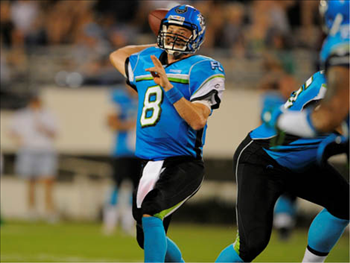
Of course, the downside is that we’d be over-saturating the talent pool a bit—look at the rosters in the United Football League (UFL) and it wouldn’t be surprising to wonder, “Quinn Gray? Isn’t he dead? I thought he died in 2002. Weird.” And the UFL kind of already has a leg up as far as goofy names and logos (although I’m sure you get lots of street cred for wearing a light blue Florida Tuskers cap in downtown Tallahassee these days).
But I still think that more football can’t help but be fun to watch, especially if we know that it means something (with apologies to the UFL’s championship game, the aptly-named UFL Championship Game…that took some marketing genius). We’d get to see some college stars sharpen their skills before getting tossed into the fires of the NFL. We’d get to see more of the 2009 UFL MVP, Brooks Bollinger, and who wouldn’t want that?
Seriously though, minor league football is an idea waiting to be realized. I just hope I’m given the proper credit when the time comes.

What, Too Soon For A Team To Be Called The New Orleans Hurricanes?
Speaking of team names, and speaking of MLS, I realized something while watching the MLS All-Star Game this week. And no, my realization was not overwhelming shame brought on by watching the MLS All-Star Game.
As the announcers desperately tried to sell the viewers on the merits of MLS, they would talk about the various teams in the league. At some point, I realized that two of the teams are named after natural disasters that happened in that city. The first one I noticed was the Chicago Fire, which I’ll grant is a cool name, and since the Great Chicago Fire happened nearly 140 years ago, I think it’s a safe enough reference to make.
But I couldn’t help but Tweet my reaction, and the follow up thoughts about teams and names that reference disasters. Ever full of sarcasm and wit, I wondered if we would see the San Francisco Earthquakes, or the Seattle Volcanoes, or the Louisiana Flood.
Turns out, as I watched more of the telecast, there actually is a team in MLS called the San Jose Earthquakes.

For one thing, I think a single earthquake is scary enough, but to have to face a team full of earthquakes…that is a contest I’m not prepared to undertake.
Is it just me, or is it a little odd that a team can be named after a disaster that happened just 21 years ago? I remember the San Francisco earthquake of 1989, mostly because it interrupted the World Series, but I still have clear mental pictures of collapsed bridges, chunks of highway uprooted and buildings falling over. This wasn’t that long ago, but it’s open for a team to be named after it?
My Tweets carry over to Facebook, so I ended up in a bit of a discussion about this phenomenon that circled back to listing a whole lot of borderline-inappropriate team names that MLS should consider. Some of the gems include the Oklahoma Cyclones, the Buffalo Blizzard (an actual team in the now-defunct National Professional Soccer League),
the Kansas Dustbowls, the South Carolina Confederates, the Dallas Grassy Knolls, and my personal favorite (courtesy of my friend Rick), the Pearl Harbor Attack.
Just to be clear, none of this is meant in a mean spirit or anything—the point is that if it’s OK to have a team named the San Jose Earthquakes just 21 years after the actual earthquake, where do we draw the line?
I’d like to further explain myself by saying that I honestly have no opinion on the matter, I just happened to find it interesting that a team/league would step out and make a decision like this. I don’t have a problem with it—to me, it’s just a team name, and should therefore be taken as such. I could write a whole lot of pages about my thoughts on people who take themselves and everything else too seriously, but I’ll save that for another time.
I guess my curiosity is such that I wonder why a team would even bother to tempt it by using a name that could have any potential negative connotation? On the other hand, part of me wants to congratulate them for taking that kind of a stand, because, as I said, it’s just a team name, and honestly, why should it be taken as anything more? It’s an interesting situation, that’s for sure.
And as I said before, if you have any thoughts on the subject, please e-mail me at sports@valleycenter.com and I’ll be sure to share what you have to say with our readers.
Just be sure to send it in right away, because (as Target keeps reminding me) summer is almost over, and the sports pages will soon be filled with all the football that’s fit to print once again!

Wednesday, July 28, 2010

The Wonders Of Comic-Con

It was right around the time when the yeti slammed down his copy of Twilight: Eclipse and stormed out of the room that I realized it had been a bit of an unusual week.
As odd as that scene may seem to most of you, I assure you that it was just one of the many fantastic sights from this year’s annual gathering of nerds, known far and wide as San Diego Comic-Con 2010.
Last year was my first time going to The Con, so I had no idea what to expect. This year was interesting because I knew what it would be like, but I still was not fully prepared for the grandeur and sheer size of the massive event.
I went in more prepared. I had my list of panels I wanted to see. I scoped out the floor on Wednesday night (I get to go on the preview night because I’m a member of the media—and also because I’m quite awesome) to get the lay of the land and feel out the booths that would be best to visit again and again for all kinds of swag.
But I still missed out on a lot of stuff. People who weren’t even there asked me afterwards, “Did you see Angelina Jolie?” or “Did you find out if Mark Ruffalo was confirmed as the new Hulk?” or “Did you get stabbed in the eye with a pen by a kid wearing a Harry Potter shirt?” (which actually happened to someone, by the way). I saw a lot of stuff, but I still came away feeling like I missed a lot as well. I suppose that’s part of the genius of The Con; even after an intense week of nerdery, you still walk away wanting more.
But getting back to the things I did experience, it wasn’t quite as awe-inspiring for me as it was last year. I guess I’ll never really recapture that childlike wonderment that comes along with the maiden voyage to Comic-Con, which is a little bit sad. But there was still lots to see, and I will do my best to recount some of the amazing sights, sounds and experiences I encountered.

The bike from the upcoming Tron movie:


Wednesday Night
I used a summer camp analogy to describe last year’s Comic-Con, and if you’ll forgive the duplication, I have just one more comparison to make—the first night of The Con is a lot like the first day at camp. You don’t really know your way around yet, the kids who got their first already called the cool cabin, and nothing’s really going full swing just yet. It’s a good night to just wander the floor aimlessly, as I did for the better part of two hours, seeing what booths are giving out good stuff (that would be the Columbia Pictures booth, featuring the movie Salt, The Green Hornet and a sequel to the movie 30 Days Of Night) and what booths are going to be lame and stingy. (Seriously, G4? You only have buttons this year, and you expect us to pay for t-shirts? Not cool.)
But one of the most amusing moments for me (I’m a word nerd, so you may not find this funny at all) was on the trolley down to the convention center. The trolley driver, explaining that this was the red line special event service train, said that we could exit the trolley at one of three stops if we were attending “The Comic-Con.” I had to Tweet about that when it happened, because (as all nerds know), it’s not “The” Comic-Con, it’s just Comic-Con. So I went about calling it The Comic-Con for the rest of the week. And I considered this to be hilarious.
The rest of Wednesday night at The Comic-Con was spent watching part of a sneak-peek at the upcoming CW network series Nikita, about an assassin who is trying to… um…assassinate people.

I couldn’t really get into it at all because the characters kept just saying what they were feeling or describing what was happening. For example, a scene in which the show’s star, Nikita, is escaping from a secure location. She gets followed to an alley behind the building and caught by a member of the security team, who also (apparently) used to know this girl and/or have a relationship with her. Anyway, the dialogue was so elementary, they were actually saying things like “You know I can’t shoot you…not after all we’ve been through…” instead of, you know, letting the flashbacks we saw tell the story about how they went through things together. I’m not saying I could do it any better, but I can at least recognize when it’s not exactly Tolkien-esque. I’ll get down off my writer’s soapbox now.

Friday Night
I skipped Thursday this year, partly to save on gas money, and partly because I am married now, and I should probably pay at least a cursory amount of attention to my bride of just over two months. Love you, sweetheart!
Anyway, I went back down on Friday night, and I could immediately tell the difference between the weekend and the earlier mid-week days. It was pretty packed, and the costumes were starting to be much more numerous (and detailed). I saw some princesses (who explicitly said, “We’re not representing Disney!” to avoid any potential lawsuits):

...as well as some interesting takes on classic characters, such as Nintendo’s Mario looked a tad suspicious with his flashy suit, big hat and stylish cane:

...and some good, homemade group costumes (the cast of Pokemon, as worn by four girls who really did a great job with the costumes):
It's hard to see this girl with the camouflage on, except that it barely covers her:

I always forget about the autograph area until the end of the day, so by the time I got up there, not very many celebrities were still around. Olivia Munn was there signing copies of her book, Suck It, Wonder Woman: The Misadventures Of A Hollywood Geek, but I missed the ticket giveaway earlier that morning, so I just snapped a photo and moved along:

Not much happened Friday night, so I went home a little early and got ready for The Comic-Con’s big day.

It's Scott Wolf! From Party Of Five! AAAHHHH!!!!

Harry Potter's cloak of invisibility:

Saturday
Let me start off the story of my Comic-Con Saturday with a little shout out to the event staff—I almost missed out on the craziness of the day, but the sympathy and kind heart of one particular staff member made it possible.
Basically, I forgot my press pass when I drove down to meet the trolley to the convention center. As I mentioned, the need to save on gas money is a priority when you get married, so there was not enough fuel to get me home again, then back down to the trolley. So I embarked for the convention center, hoping that my press confirmation letter and photo ID would be enough.
The official policy of Comic-Con is that they don’t reissue press passes. To replace a lost attendee badge costs $100. I talked to four different people at three different locations, and there appeared to be nothing they could do.
Well, after talking with one of the supervisors, and assuring them that I had not sold my pass or anything like that, she took pity on me and issued me a one-day press pass for no charge. I won’t mention her name, just in case there would be any trouble she could get into, but I thanked her profusely and headed off to the exhibit hall once again.
Saturday at The Comic-Con is a new world full of bright colors, loud, random sounds and a whirlwind of activity that will turn your brain upside-down. It reminds me of the time I accidentally took too much Benadryl (and by too much, I mean I took one pill—I’m apparently a wimp when it comes to medicine) and ended up feeling loopy and unsure of spatial stimuli and tactile input for an entire evening.
But instead of feeling out of it, the excitement of the exhibition floor gets you pumped up for a day of costumes, celebrities and… well, waiting in line for upwards of two hours just to see something worth seeing. Woo hoo!

Batman gets interviewed...because he's always so available, after all:

Yes, there was some Twilight gear there.

At least it didn't ruin Comic-Con this year, like it did last year, apparently.

Celebrities were everywhere, from Chris Evans and Hugo Weaving (from the new Captain America movie) at the Marvel booth...

...to Michael Chiklis (who played The Thing in the Fantastic Four movies)...

to Seth MacFarlane (creator of Family Guy and The Cleveland Show)...
No, I didn’t see Angelina Jolie, or Will Ferrell, or Chevy Chase. Oh wait, I did see Chevy Chase.

And I totally nodded my head in his general direction as he walked by. We’re pretty much best friends now.
The costumes were amazing, from (my personal favorite) Colonel Sanders...

...to Gandalf...

to Voltron...
...to whatever this is...

...and that’s before the Masquerade even began. But we’ll get to that in a bit.
I had to go to the Attack Of The Show (AOTS) panel, mostly because it’s a hilarious show on G4 that shows the latest internet video sensations, gadget reviews, movie news and general awesomeness. Also, the hosts, Kevin Pereira and Olivia Munn, are really funny. I pretty much stalked Miss Munn last year at The Con, even participating in the now-famous Running Of The Munns that took place when one of her autograph sessions had to be moved at the last minute. I'm sure she's used to it.
Anyway, the AOTS panel brought the goods, as it does every year, with a contest to see which nerd could best imitate the now-famous “Double Rainbow” video clip that’s been circling the Web. They also had a bingo contest regarding the things that would happen during the panel. Some of the possible goings-on included “Sexy Yeti Sighting,” “AOTS Batman Surprises Kevin,” and “Zombie Apocalypse.” I did not win the bingo, but whoever had “Yeti Gets Upset With The Ending To The Twilight Series” got some fabulous prizes.
I got a couple autographs...

...took a photo with Pereira...

and boogied out to see what else was happening.
Turns out they close the exhibition hall at 7 p.m., but there was still plenty to see. In my wanderings, I happened upon the line for the Masquerade, an event I missed last year. They still had tickets, so I grabbed one and wondered (with some trepidation) if I would be forced to slow dance.
To my great relief, I did not. From the comfort of my seat, I was able to watch what was essentially a fashion show combined with an improv class, all featuring some awesome costumes.
Some were marvels of engineering, like the Amp suit from the movie Avatar:

...or the entirely-homemade minotaur:

...or the crowd-favorite Puff The Magic Dragon:

Others were great because of the presentation, such as the Xavier School Musical (the X-Men cartoon characters singing and dancing, like in that series of teen song-and-dance movies that shall not be named):

and the mish-mash of time-traveling heroes that included Bill & Ted, Dr. Who, Sam Beckett and Ziggy (from Quantum Leap) and, of course, Doc Brown and Marty McFly:

And some were just plain awesome, like the kid with the War Machine (from Iron Man 2) costume:

...or the Avatar vs. Avatar showdown (between the main characters from Avatar: The Last Airbender and James Cameron’s Avatar):

...or the winner of Best In Show, a group called Viva Las Villains that featured some famous comic book villains as they might appear in their own series of casinos:

The costumes were amazing, the presentation varied from uncomfortable to genuinely clever and funny, and the atmosphere was electric. Nerds love their cosplay, I suppose.
All told, it was a great week. I even had a few observations gathered over the course of The Comic-Con this year.
—There was a tremendous amount of diversity in the crowd, which shouldn’t really be a surprise in 2010, but was still noteworthy in a socially positive sense. From the black guy dressed as Batman Beyond:

...to the Asian kid dressed as “super” hero Kick-A**:

...to the Hispanic Jedi warrior I waited in line with to get a tin of red hots from the WB booth.
The world of the nerd apparently knows no boundaries, and The Comic-Con was a perfect example.
—The best swag (which stands for Stuff We All Get) came from the aforementioned Columbia Pictures booth, where they handed out three different free t-shirts, posters, buttons, and, on occasion, packages of microwave popcorn. They did it right—sometimes they weren’t handing out anything, sometimes you got a bunch of stuff. You had to check back at random times to see if you could score something cool.
The booth that was so close to getting it right was the booth for Millenium Films, featuring upcoming releases Red, Drive Angry and The Expendables. They gave out free t-shirts, but with a catch—you had to go to a different part of the exhibition hall to wait in line, and they only gave out a limited number, so the line was immediately full as soon as it opened. They gave away a lot of other stuff, including refrigerator magnets and keychains, but it mostly cluttered up my backpack and after the second day of it, nobody really wanted another cord organizer from the upcoming movie Sourcecode.
I was pretty disappointed with the G4 booth, which gave away lots of stuff last year, but insisted on selling stuff this year. They handed out buttons this year, but compared to last year’s giveaways of shirts, rub-on tattoos, photos, posters and even green plastic visors, it was just sad. Same with the WB booth, which clearly had enough foot traffic to justify some cool handouts, but only passed out little red hots in a Vampire Diaries tin, a free Harry Potter broomstick for your character on Xbox Live, some little buttons, and a card to go to another booth to get a Big Bang Theory button. For one thing, don’t make me stand in line all that time just to send me on an errand. And for another thing, come on folks, it’s The Comic-Con. This is not the time to skimp.
—As always, there was a lot I kind of saw but didn’t get to investigate. There is apparently a new Medal Of Honor video game coming out (I was a HUGE fan of the MOH series when it was on Playstation 1 & 2, when it was about World War II, but this one looks like it involves modern wars), and I didn’t really get down to the Marvel booth that often (they didn’t hand out much, and it was a little ways away from the main booths congregated in the center of the exhibition hall). I heard a lot about different panels, but you can pretty much only see one panel a day (unless you stay for back-to-back panels in the same room) because the lines get so long so quickly.
I wish I’d had a little more time to check out the autograph area as well; I did take some photos of the scattered celebrities who were left on Saturday night (including the voice cast of Futurama:

...as well as the guy who played The Soup Nazi on Seinfeld):

but I didn’t get any sweet autographs this year.
But there were a couple of random sightings that made my week, in a weird way. I checked out last year’s Comic-Con photos, and found this picture of a nerdy kid with big white shoes riding the trolley the first day:

Well, I saw him on the trolley again this year, but in a much bigger crowd, so I couldn’t get a shot of him. I saw another guy, also from last year’s trolley ride (this nerdy guy, who was thoroughly engrossed in his bag of goodies):

...on the trolley ride home on Saturday. In a weird way, it was a cool way to end my Comic-Con experience this year, as if seeing those guys brought it all around, full-circle.
And it reminded me that no matter how cool I get, or how many times I see an angry yeti storm off a stage, I’m just a big, nerdy kid inside.
Be sure to write in if you have any thoughts about Comic-Con, or if you have any photos from The Con that you'd like to share.